
Ir al contenido
Hico
  • Inicio
  • Tienda
  • PRO-RACING DIVISION
  • Sobre Nosotros
  • Contáctanos
  • Guías Técnicas
  • 0
  • Tel: +1 (321) 209-0815 WA:+13213337402

  • Síganos
  • English (CA) English (UK) English (US) Français (CA) Português (BR) Español (América Latina)
  • Inicia sesión
  • Contáctanos
Hico
  • 0
    • Inicio
    • Tienda
    • PRO-RACING DIVISION
    • Sobre Nosotros
    • Contáctanos
    • Guías Técnicas
  • Tel: +1 (321) 209-0815 WA:+13213337402

  • Síganos
  • English (CA) English (UK) English (US) Français (CA) Português (BR) Español (América Latina)
  • Inicia sesión
  • Contáctanos

Signos Comunes de Sellos de Transmisión Dañados a Tener en Cuenta

Identify fluid leak colors, low-pressure symptoms, and slipping gears before costly transmission damage occurs.
  • Todos los blogs
  • ​Guías Técnicas
  • Signos Comunes de Sellos de Transmisión Dañados a Tener en Cuenta
  • 14 de octubre de 2026 por
    Signos Comunes de Sellos de Transmisión Dañados a Tener en Cuenta
    Team Export
    transmission seals, fluid leak

    Most transmission problems don't start with a dramatic breakdown on the highway. They start with a few drops of red fluid on the driveway that nobody bothers to investigate. Transmission seals are cheap parts, often just a few dollars each, but when they fail, they can take an expensive component down with them.

    The frustrating part is that seal failure is usually slow and fairly easy to spot if you know what to look for. A seal that weeps for months gives you plenty of warning before the transmission runs low enough to cause real damage. Drivers who ignore those warnings often end up paying for a rebuild instead of a gasket kit, and the price gap between those two repairs can be enormous.

    This guide walks through the most reliable signs of bad transmission seals, from what you'll see under the car to what you'll feel behind the wheel. None of it requires a lift or special tools to notice, just a little attention and a willingness to look under your vehicle once in a while.

    Understanding the Role of Transmission Seals

    A transmission is a sealed hydraulic system. Automatic transmissions in particular depend on pressurized fluid to engage clutches, operate valve bodies, cool internal parts, and lubricate gears. Seals are what keep that fluid where it belongs while allowing shafts to spin and components to move.

    You'll find several types throughout the unit:

    • Front pump seal: Sits where the torque converter meets the transmission and keeps fluid from escaping at the bell housing.
    • Rear output shaft seal: Seals the point where the driveshaft or axle exits the transmission.
    • Axle seals: On front-wheel-drive vehicles, these seal the CV axles entering the transaxle.
    • Pan gasket: Seals the fluid pan on the bottom of the transmission.
    • Shifter and sensor seals: Small O-rings around the shift shaft, speed sensors, and electrical connectors.
    • Cooler line fittings: Connections where fluid travels to and from the radiator or external cooler.

    Most of these are made from rubber compounds or synthetic materials that harden over time. Heat cycles, age, and contaminated fluid all cause them to shrink, crack, or lose flexibility. A seal on a 12-year-old vehicle with 150,000 miles has been through thousands of heating and cooling cycles, so some leakage at that point isn't surprising. What matters is catching it before fluid levels drop far enough to cause internal damage.

    Visual Indicators of Seal Deterioration

    Your eyes are the best diagnostic tool you have here. Leaks almost always show up visually before they show up in how the car drives, which gives you a real head start.

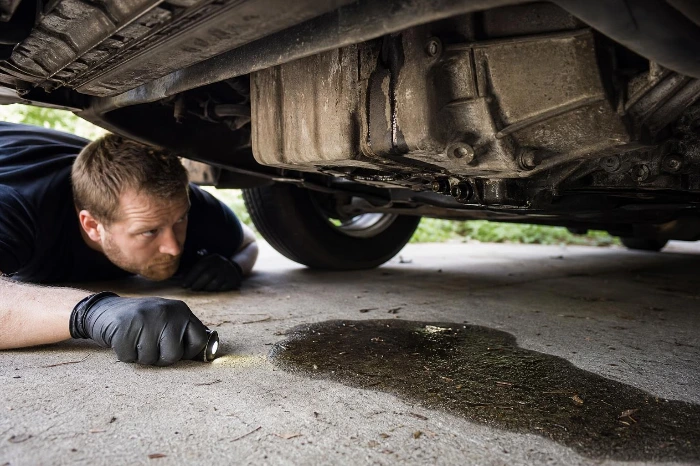
    Identifying Transmission Fluid Puddles

    Automatic transmission fluid is usually dyed red or pink when fresh. As it ages, it darkens toward brown. That color helps you tell it apart from other fluids your car might drip:

    • Red or pink, slightly oily: Transmission fluid (or power steering fluid on some older vehicles).
    • Brown to black: Engine oil, or very old transmission fluid.
    • Bright green, orange, or pink with a sweet smell: Coolant.
    • Clear and watery: Usually AC condensation, which is normal.

    Location matters too. Transmission leaks typically appear under the middle of the car, roughly below the front seats on rear-wheel-drive vehicles, or slightly behind the engine on front-wheel-drive models. A simple trick is to slide a piece of white cardboard under the car overnight. By morning, you'll see the color, size, and exact spot of any drip.

    A few drops after a week of parking might be a slow weep. A spot the size of your palm every morning means the seal is actively failing and needs attention soon.

    Checking for Wetness Around the Housing

    Not every leak drips. Many failing seals simply leave the transmission case coated in a film of fluid that attracts dirt and road grime. If you look underneath and see a dark, greasy, caked-on layer around the pan edge, output shaft, or where the axles enter, that's a strong indicator of seepage.

    Run a clean rag or paper towel along the suspect area. Reddish residue confirms transmission fluid. Pay special attention to the seam between the engine and transmission: fluid there often points to the front pump seal, which is one of the more labor-intensive repairs because the transmission usually has to come out.

    Keep in mind that fluid travels. Air flow under a moving car can push a leak several inches from its source, so the wettest spot isn't always where the seal actually failed. A mechanic may clean the area and add UV dye to the fluid to pinpoint the exact origin.

    Performance Issues Linked to Low Fluid Pressure

    Once enough fluid escapes, the transmission can't build the hydraulic pressure it needs. This is where leaks stop being a cosmetic issue and become a driving problem. Some of the most telling signs of bad transmission seals show up as changes in how the vehicle shifts and accelerates.

    Delayed Engagement and Gear Slippage

    Shift from park into drive and count. A healthy automatic engages almost immediately, usually in under a second. If you notice a pause of two or three seconds before you feel the gear catch, low fluid is a likely cause, especially when the delay is worse on cold mornings.

    Slipping feels different. You press the accelerator, the engine revs, but the car doesn't pull with matching force. It's as if the transmission briefly drops into neutral and then grabs again. This happens because the clutch packs aren't getting enough pressure to clamp fully, so they slip against each other. Every slip generates heat and wears friction material, which means the problem compounds quickly.

    Erratic Shifting and Increased RPMs

    Low fluid also throws off shift timing. You might notice hard, clunky shifts, shifts that happen later than usual, or a transmission that hunts back and forth between gears on a steady highway cruise. Some modern transmissions will go into a limp mode, locking into a single gear to protect themselves, and trigger a check engine light.

    Watch your tachometer. If your engine typically sits around 2,000 RPM at highway speed and now reads noticeably higher with no change in speed, the torque converter or clutches may be slipping. That rise in RPM without a matching rise in speed is a classic symptom of the transmission not transferring power efficiently. Combined with a visible leak, it's a strong hint that lost fluid is behind the problem.

    Auditory and Sensory Warning Signs

    Transmissions running low on fluid tend to get noisy. A whining or humming sound that rises and falls with engine speed often comes from the pump struggling to pull fluid that isn't there. You'll sometimes hear it most clearly when the car is in gear but stationary, like at a red light.

    Other sounds worth paying attention to include a buzzing noise from underneath, a clunk when shifting into drive or reverse, or grinding during gear changes. On manual transmissions, low gear oil from a failing seal can make shifts notchy and cause a growling sound that gets louder in specific gears.

    Feel matters as much as sound. Shuddering at low speeds, particularly between 30 and 45 mph, can point to torque converter problems aggravated by low or degraded fluid. Vibration through the floor or shifter during gear changes is another clue. None of these sensations prove a seal has failed on their own, but if you've already spotted fluid under the car, they confirm that the leak has progressed beyond a minor nuisance. At that point, waiting is the expensive choice.

    The Risk of Overheating and Burning Smells

    Transmission fluid does double duty as a coolant. When the level drops, the remaining fluid has to absorb more heat, and it breaks down faster as a result. This creates a cycle: less fluid means more heat, more heat degrades the fluid, and degraded fluid protects internal parts less effectively.

    A burning smell is one of the more urgent warnings in this whole list. It often smells acrid and slightly sweet, different from burning engine oil. You might catch it after a long drive, while towing, or when sitting in stop-and-go traffic on a hot day. It can mean two things, and both are bad:

    1. Leaking fluid is dripping onto a hot exhaust component and cooking off.
    2. The fluid inside the transmission is overheating and clutch material is burning.

    Check your dipstick if your vehicle has one. Healthy fluid is bright red and smells mostly neutral. Dark brown fluid with a burnt odor, or fluid with tiny metallic flecks, signals heat damage that may already have affected internal parts. Many newer vehicles have sealed transmissions without a dipstick, so a shop may need to check the level through a fill plug.

    If you smell burning fluid and see smoke, pull over and let the vehicle cool. Fluid on a hot exhaust is a genuine fire risk.

    Preventing Catastrophic Transmission Failure

    The good news is that seal problems are among the most preventable transmission failures. A few habits go a long way:

    • Look underneath monthly. A 30-second glance at your parking spot and the transmission case catches most leaks early.
    • Check fluid level and condition on schedule if your vehicle allows it, and note any changes in color or smell.
    • Follow the fluid service interval in your owner's manual. Fresh fluid keeps seals conditioned and reduces heat-related hardening. If you tow or drive in heavy traffic, use the severe-service schedule.
    • Use the correct fluid type. Modern transmissions are picky, and the wrong fluid can swell or shrink seals.
    • Don't rely on stop-leak additives long term. They can soften old seals temporarily, but they're a bandage, not a repair.
    • Fix small leaks promptly. An output shaft or axle seal is often a modest repair, while a burned-up transmission can cost thousands.

    These warning signs rarely appear all at once. Usually it's a stain on the driveway first, then a slight delay into drive, then a whine or a smell. Each stage you catch earlier saves money and stress. If you've noticed any of the signs of bad transmission seals covered here, have a qualified technician inspect the vehicle soon. A seal costs very little to replace, and the transmission it protects is one of the most expensive parts of your car.

    en ​Guías Técnicas
    # Transtec
    Guía del Kit de Embrague OS Giken: Placa Doble vs Placa Simple para Construcciones de Rendimiento
    Discover the differences between single, twin, and multi-plate OS Giken clutches to choose the right setup for your high-horsepower engine.

    Cada embrague se ve bien en una hoja de dinamómetro hasta que el aumento de presión entra a 6,500 rpm y el tacómetro sube mientras el auto no lo hace. Ese momento generalmente envía a los constructores en busca de un embrague más fuerte, y OS Giken aparece rápidamente en esas búsquedas. Esta guía compara las opciones de placa doble y placa simple de OS Giken para construcciones de rendimiento para que puedas hacer coincidir el hardware con cómo se conduce realmente tu auto.

    La elección importa más de lo que la mayoría de la gente espera. Elegir un embrague demasiado pequeño significa deslizamiento y superficies de fricción vidriadas en unos pocos días de pista. Elegir un embrague demasiado grande hace que el auto sea miserable en el tráfico, chirriando y agarrando como un auto de carreras en un viaje al supermercado. La respuesta correcta depende del par, el uso y cuánto confort diario estás dispuesto a sacrificar.

    ¿Qué Hace que los Embragues OS Giken Sean Superiores para Construcciones de Alto Caballo de Fuerza?

    OS Giken ha fabricado componentes de tren motriz en Japón durante décadas, y sus embragues reflejan una mentalidad de ingeniería de motorsport en lugar de un enfoque de instalación de posventa. La ventaja principal es cómo el embrague gestiona el calor y la carga de sujeción juntos, ya que esos dos factores deciden si un embrague sobrevive a lanzamientos repetidos de alto par.

    El calor es el verdadero enemigo. Cada vez que un embrague patina durante la conexión, la energía de fricción se convierte en calor, y una vez que el material de fricción supera su temperatura de trabajo, el coeficiente de fricción disminuye y el deslizamiento se alimenta a sí mismo. OS Giken diseña para distribuir esa carga a través de superficies de fricción mecanizadas con precisión y componentes ligeros que disipan el calor rápidamente entre cambios. En unidades de múltiples discos, la energía se divide en una mayor área de superficie, por lo que cada disco funciona más frío bajo el mismo abuso.

    La capacidad de torque proviene de la geometría en lugar de la presión bruta del resorte. Agregar superficies de fricción aumenta la potencia de sujeción sin necesidad de una carga de sujeción punitiva, lo que mantiene el esfuerzo del pedal razonable y reduce el estrés en el rodamiento de liberación, la horquilla y el rodamiento de empuje del cigüeñal. Ese es el intercambio de ingeniería que la mayoría de los embragues "stage" baratos hacen mal: aumentan la fuerza del resorte y dan por terminado el asunto.

    El resultado es una conexión predecible a altos niveles de potencia, un comportamiento consistente cuando el embrague está caliente, y un componente que mantiene su torque nominal vuelta tras vuelta en lugar de desvanecerse durante la tercera sesión.

    Kits de Embrague OS Giken de Disco Simple vs. Disco Doble: Diferencias Clave

    La forma más simple de enmarcarlo: un disco simple te da un par de superficies de fricción, y un disco doble te da dos. Duplicar la superficie de fricción aproximadamente duplica la capacidad de sujeción con una carga de sujeción similar, pero cambia cómo se siente y se comporta el embrague en todos los demás aspectos.

    Factor

    Disco Simple

    Disco Doble

    Sensación del pedal

    Progresiva, más cercana a OEM

    Más firme, zona de conexión más corta

    Conexión

    Lanzamientos suaves y indulgentes

    Rápido, más carácter de encendido/apagado

    Límite de potencia

    Moderado a fuerte NA y aumento leve

    Aumento alto, gran torque, uso intensivo en pista

    Ruido

    Generalmente silencioso

    Un poco de vibración al ralentí es normal

    Masa rotativa

    Depende de la elección del volante de inercia

    A menudo ensamblaje más ligero para revoluciones rápidas

    El OS Giken de Placa Única Amigable para la Calle

    La placa única es adecuada para motores naturalmente aspirados fuertes y configuraciones moderadamente sobrealimentadas que aún recorren millas en la calle. La conexión es progresiva, por lo que arrancar en una colina o avanzar lentamente por un garaje no requiere movimientos quirúrgicos del pie. El esfuerzo del pedal se mantiene lo suficientemente cerca del stock como para que un pasajero no note nada inusual.

    Para un K24 bien construido que genera una potencia NA sólida o un auto turbo que opera con un aumento conservador, una placa única a menudo proporciona toda la potencia de sujeción requerida. También cuesta menos comprar y mantener, lo cual es importante cuando estás presupuestando toda la construcción.

    El OS Giken de Placa Doble Enfocado en Pista

    La placa doble está diseñada para conductores que regularmente aplican un torque serio a la transmisión. Dos discos significan una capacidad de sujeción mucho mayor, mejor gestión del calor durante lanzamientos repetidos y estabilidad a través de largas sesiones en pista donde un disco único comenzaría a desvanecerse.

    El compromiso es el carácter. La conexión ocurre en un rango de pedal más corto, los lanzamientos requieren más precisión y algo de vibración o ruido de engranaje al ralentí es parte del trato. Los propietarios que entienden esto desde el principio tienden a amarlo. Los propietarios que esperan modales OEM generalmente no.

    Señales de que necesitas una actualización de embrague OS Giken de Placa Doble

    No todas las construcciones necesitan una placa doble, pero algunas claramente sí. Estos son los indicadores de que una placa única ha alcanzado su límite:

    • Deslizamiento bajo alta presión. Si las revoluciones aumentan en tercera o cuarta marcha cuando el turbo alcanza su punto máximo, especialmente una vez que todo está caliente, el embrague no puede soportar el par máximo. El deslizamiento en marchas más altas a plena carga es el síntoma clásico.

    • Par más allá de la clasificación de un solo disco. Verifica la capacidad nominal del fabricante para tu kit. Si tus números en el dinamómetro están cerca o por encima de esa cifra después de una actualización de turbo, inyectores más grandes o una nueva afinación, estás funcionando sin margen. Un disco doble restaura ese margen.

    • Uso intensivo en pista. Lanzamientos duros repetidos, pasadas de arrastre o largas sesiones en pista calientan el embrague mucho más allá de lo que hace la conducción en la calle. Un olor a quemado después de una sesión o un compromiso que cambia a medida que el auto se calienta apunta a sobrecarga térmica.

    • Discos vidriados o desgastados rápidamente. Sacar un disco único que se ve brillante, azulado o desgastado después de una corta vida útil te dice que está siendo sobrecargado.

    • Aumentos de potencia planificados. Si la próxima fase de tu construcción agrega un par significativo, instala el disco doble ahora en lugar de hacer el trabajo del embrague dos veces.

    Una regla útil del taller: si te estás preguntando si tienes suficiente embrague, probablemente necesites mirar el siguiente nivel. Los embragues no fallan gradualmente cuando son insuficientes. Funcionan hasta un tirón fuerte, luego ya no.

    Compatibilidad del Embrague OS Giken: Honda K-Series (K20/K24) y más allá

    La serie K de Honda es una de las plataformas más comunes para los kits de embrague OS Giken, y por una buena razón. El K20 y el K24 responden extremadamente bien a la modificación, ya sea que se trate de construcciones NA de alta compresión que giran más allá de 8,000 rpm o configuraciones turbo que generan varias veces su producción de fábrica. El embrague de fábrica nunca fue diseñado para ninguno de los dos.

    Para las construcciones K20 que permanecen naturalmente aspiradas, el atractivo a menudo es la reducción de la masa rotativa. Un embrague y un volante más ligeros permiten que el motor gire más libremente, lo que se adapta al carácter de alto régimen del K20 y hace que los cambios de marcha de talón a punta sean más precisos. El K24, con su desplazamiento y par adicionales, presiona el embrague más fuerte desde más abajo en el rango de revoluciones, por lo que un K24 sobrealimentado es un candidato ideal para un plato doble.

    Las aplicaciones comunes de la serie K incluyen Civic Type R, Integra RSX, Civic Si y chasis de intercambio de motor como el Civic EG y EK o el S2000. Los intercambios requieren atención cuidadosa a qué transmisión estás utilizando, ya que los detalles de la campana y el eje de entrada determinan el kit correcto, no solo el código del motor.

    Más allá de Honda, OS Giken apoya una amplia gama de plataformas de rendimiento, incluidos los motores Nissan SR20 y RB, aplicaciones Toyota 2JZ y 86/GR86, motores Subaru EJ y FA, y Mitsubishi 4G63. Siempre confirma el número de parte exacto con tu motor, transmisión y año del modelo antes de ordenar.

    Procedimiento de Rodaje Adecuado para Embragues Multi-Plato OS Giken

    Un nuevo embrague necesita tiempo para que las superficies de fricción se acoplen adecuadamente con el volante, la placa de presión y la placa intermedia. Saltarse esto y arriesgas un contacto desigual, puntos calientes, vitrificación y ruidos que nunca desaparecen por completo. El costo de la paciencia es unos pocos cientos de millas. El costo de la impaciencia es otro trabajo de embrague.

    Sigue estos pasos después de la instalación:

    1. Confirma la instalación antes de conducir. Verifica el par correcto en los tornillos de la placa de presión en un patrón de cruz, revisa el juego libre del pedal y el sangrado hidráulico, y asegúrate de que el embrague se desacople completamente antes del primer viaje.

    2. Conduce suavemente durante las primeras 300 a 500 millas. Utiliza la cifra recomendada por el fabricante para tu kit específico y mantén el compromiso suave con un acelerador moderado.

    3. Evita lanzamientos a plena aceleración y cambios agresivos. No inicies arranques en drag, no hagas patadas de embrague, no realices descargas a altas revoluciones durante este período.

    4. Varía tu compromiso. Conducir normalmente en paradas y arranques con un compromiso de rpm moderado ayuda a que las superficies se asienten uniformemente. Conducir en ciudad y en carretera funciona bien.

    5. Evita el deslizamiento prolongado. Mantener el embrague presionado genera calor antes de que las superficies se asienten correctamente.

    6. Revisa el ajuste del pedal después del periodo de rodaje. El punto de compromiso puede cambiar ligeramente a medida que las superficies se asientan.

    Espera algo de ruido de las unidades de doble disco al ralentí. Son los discos flotantes y no es un signo de un rodaje inadecuado.

    Seleccionando el Socio de Tren Motriz de Rendimiento Correcto

    La decisión entre disco simple y disco doble se reduce a respuestas honestas sobre tu construcción. Un disco simple mantiene el coche agradable en la calle y maneja bien configuraciones de NA fuertes y de impulso moderado. Un disco doble gana su lugar una vez que el par supera lo que un disco puede sostener de manera confiable, o cuando el calor repetido de la pista comienza a cocinar las superficies de fricción. Combina el embrague con tu cifra real de par y tu conducción real, luego dale un rodaje adecuado para que dure.

    Dónde compras importa tanto como lo que compras. Las piezas de transmisión falsificadas y del mercado gris circulan, y un embrague es el último lugar donde quieres materiales o tolerancias cuestionables. HICOStore es un distribuidor autorizado de piezas de rendimiento genuinas de OS Giken, con envío rápido a través de EE. UU. e internacionalmente. Confirma tu plataforma, elige la configuración correcta y ordena de una fuente en la que puedas confiar, porque el mejor embrague es aquel del que nunca tienes que volver a pensar.

    Piezas de carreras, transmisión de motorsport, caja de cambios secuencial, clutch de alta potencia, distribuidor de carreras JDM.
    • Inicio
    • Sobre nosotros
    • Productos


    • Política de Privacidad Política de Reembolso y Devolución Términos de Servicio
    Síganos
    Hicostore.com es una marca global propiedad de HICO GROUP. En el Reino Unido y Europa, los servicios son proporcionados por HICOSTORE LTD (Número de Empresa 17035559). En los Estados Unidos, los servicios son proporcionados por Hicostore Group Holdings LLC
    English (CA) | English (UK) | English (US) | Français (CA) | Português (BR) | Español (América Latina)
    Con la tecnología de Odoo - El mejor Comercio electrónico de código abierto

    Utilizamos cookies para proporcionarle una mejor experiencia de usuario en este sitio web. Política de cookies

    Solo las necesarias Estoy de acuerdo