Skip to Content
Hico
  • Accueil
  • Magasin
  • Division Pro-Racing
  • À propos de nous
  • Guides Techniques
  • Contactez-nous
  • 0
  • Tél : +1 (321) 209-0815 WA : +13213337402

  • Follow us
  • English (CA) English (UK) English (US) Français (CA) Português (BR) Español (América Latina)
  • Sign in
  • Contactez-nous
Hico
  • 0
    • Accueil
    • Magasin
    • Division Pro-Racing
    • À propos de nous
    • Guides Techniques
    • Contactez-nous
  • Tél : +1 (321) 209-0815 WA : +13213337402

  • Follow us
  • English (CA) English (UK) English (US) Français (CA) Português (BR) Español (América Latina)
  • Sign in
  • Contactez-nous

Corteco Tractor & Agricultural Seals: Heavy-Duty Sealing Solutions for Farm Machinery

Heavy-Duty Agricultural Sealing: Why Standard Automotive Seals Fail in the Field
  • ​Technical Guides
  • Corteco Tractor & Agricultural Seals: Heavy-Duty Sealing Solutions for Farm Machinery
  • October 19, 2026 par
    Roger Flores


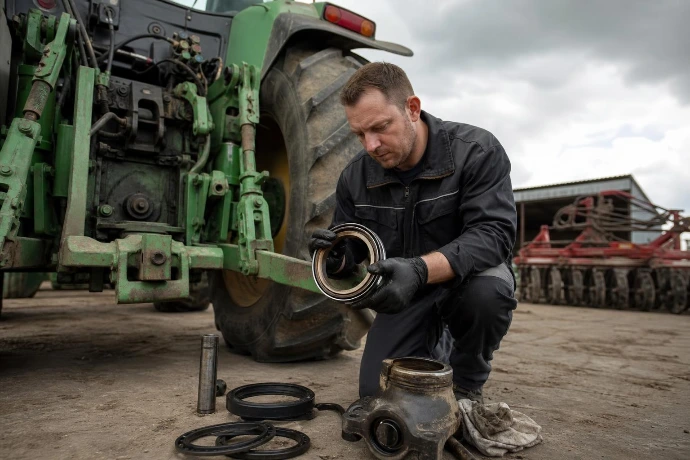
    Every spring, somewhere in a machine shed, a mechanic pulls a wheel hub and finds grease that looks more like wet concrete than lubricant. The bearing is pitted, the shaft is scored, and the seal that was supposed to prevent all of it is torn or glazed flat. It almost always happens at the worst time: a week before planting or halfway through harvest, when a tractor sitting idle costs far more than any part.

    Seals are some of the cheapest components on a tractor, yet they protect some of the most expensive ones. Bearings, gears, hydraulic pumps and final drives all depend on a thin elastomer lip holding oil in and dirt out. When that lip fails, the repair bill grows fast.

    That is why Corteco tractor and agricultural seals have earned a loyal following among dealers, independent shops and farmers who do their own wrenching. The sections below cover why farm equipment needs purpose-built sealing, how cassette designs work, where they matter most, and how to fit them so they last.

    Heavy-Duty Agricultural Sealing: Why Standard Automotive Seals Fail in the Field

    A passenger car seal lives a fairly sheltered life. It sees road spray, some dust and the occasional car wash, but the wheel spins on paved surfaces and the vehicle rarely sits submerged in anything. A tractor axle seal faces a completely different set of conditions, and a standard automotive design simply wasn't built for them.

    Start with soil. Fine silt and sand behave like lapping compound once they reach a seal lip. Each rotation drags abrasive particles across the contact surface, wearing a groove into the elastomer and eventually into the shaft itself. In wet clay, the problem gets worse: mud packs against the seal face, dries, and holds grit right where it does the most damage.

    Then there's cleaning. Pressure washers are standard practice on farms, especially before moving equipment between fields to limit weed seed and disease spread, or before servicing. A high-pressure jet aimed at a hub can force water past a single-lip seal in seconds. Once moisture gets inside, it emulsifies the grease and starts corrosion on bearing races.

    Other stresses stack on top:

    • Temperature swings from frosty mornings to hot afternoons under load

    • Shaft misalignment and runout from heavy implements and uneven ground

    • Long idle periods during the off-season, which let lips take a set and dry out

    • Chemical exposure from fertilizers, slurry and crop protection products

    A seal designed only to retain oil, without serious exclusion capability, will lose this fight. Agricultural sealing has to treat keeping contamination out as just as important as keeping lubricant in.

    Corteco Cassette Seals: Multi-Lip Protection Against Mud, Dust, and Water Ingress

    A conventional radial shaft seal is a simple idea: a metal case, a rubber lip, and a garter spring pressing that lip against a rotating shaft. It works well in clean conditions. Its weakness is that the primary sealing lip is also the first line of defense, so every grain of dirt that arrives hits the most important surface directly.

    Cassette seals solve this by changing the architecture. Instead of a lip running directly on the customer's shaft, a cassette is a self-contained unit with its own inner and outer sleeves. Several lips, both radial and axial, are arranged between those sleeves to form a labyrinth. Contaminants have to travel a winding path past multiple barriers before they get anywhere near the primary oil-retaining lip.

    Corteco's cassette designs use that labyrinth principle to stage the protection. The outer lips and dust excluders take the brunt of mud and water. Any debris that makes it past them gets trapped in grease-filled cavities between the lips. The primary lip, sitting deepest in the assembly, ends up running in a relatively clean environment and keeps sealing long after a single-lip design would have failed.

    There's a second advantage that shop technicians appreciate. Because the lips run on the cassette's own precision-finished sleeve rather than the shaft, minor wear on the original shaft matters less. The running surface comes with the seal, and its finish is controlled at the factory.

    For hubs and axles that spend their lives in slurry, standing water and dust clouds, this multi-lip approach is the difference between a seal that lasts a season and one that lasts years.

    Critical Agricultural Applications: Axles, PTO Shafts, Wheel Hubs & Transmissions

    Each major driveline component puts its own demands on a seal, and the best results come from matching the design and material to the job.

    Axles carry the full weight of the tractor plus whatever it's pulling or carrying, so they deal with heavy radial loads and some shaft deflection. Front axles on four-wheel-drive machines also sit low and close to the mud, which makes contamination exclusion the priority. This is classic cassette territory.

    PTO shafts are a different story. They spin fast, commonly at the standard 540 or 1,000 rpm, and they transmit serious torque to balers, mowers, harvesters and pumps. Higher surface speed means more heat at the lip contact, so lip geometry and compound selection have to manage friction without hardening or cracking. A PTO seal also sits right at the rear of the tractor, exposed to crop residue that wraps around the shaft.

    Wheel hubs combine rotation, load and full exposure to the elements. Field washing hits them directly, and on trailed implements they may sit unused for months. Seals here need strong exclusion and good resistance to aging.

    Transmissions and final drives keep oil in under pressure and temperature, often with additives that attack weaker elastomers. Here, material chemistry matters most.

    Corteco supplies OE-quality materials across these applications, including compounds such as NBR, HNBR and FKM chosen for their temperature range and oil compatibility. That attention to material lets the seals cope with the high torque, rotational speeds and long duty cycles typical of modern farm machinery, rather than just fitting the housing on day one.

    Replacing Heavy-Duty Seals on John Deere, Massey Ferguson, Case IH, and New Holland Equipment

    Most farm fleets are mixed. One operator might run a John Deere row-crop tractor, an older Massey Ferguson for yard work, a Case IH combine and a New Holland baler. When something leaks, nobody wants to chase three suppliers and wait two weeks for a part.

    Corteco's range is built around direct replacement for these major brands. Seals are cross-referenced to OEM part numbers, so a technician can look up the original number from the parts book or the old seal itself and find the matching Corteco equivalent. Dimensions, lip configuration and materials are specified to fit the original housing and shaft, which means no machining, no shimming and no improvising.

    A perfect fit matters more than many people realize. A seal that's slightly oversized in the bore can distort when pressed in, creating uneven lip pressure. One that's undersized can spin in its housing or weep oil around the outer diameter. Either way, the repair has to be done twice. Using a properly engineered replacement restores the original sealing performance instead of approximating it.

    A few practical tips help when ordering:

    1. Record the full part number stamped on the old seal before discarding it.

    2. Note the machine serial number, since manufacturers sometimes change seal specs mid-production.

    3. Replace mating components such as wear sleeves when the shaft surface is damaged.

    4. Order axle seals in pairs for both sides, because if one has failed, the other is usually close behind.

    With the right cross-reference, these sealing solutions for farm machinery turn a potential week-long wait into a same-day job.

    Best Practices for Heavy-Duty Seal Installation and Maintenance to Prevent Costly Downtime

    A quality seal can still fail early if it goes in wrong. A large share of premature leaks trace back to installation rather than product defects, and almost all of those are avoidable.

    Proper Tooling and Surface Preparation

    Never fit a seal with a hammer and a drift punched around the edge. That approach cocks the seal in the bore, dents the case and can dislodge the spring. Use a proper seating tool or a driver that matches the seal's outer diameter and contacts the case evenly. For cassette seals, follow the manufacturer's guidance exactly, since pressing on the wrong face can damage the internal lips.

    Before installing anything, inspect the shaft. Run a fingernail across the old lip track. If you can feel a groove, the new lip will not seal reliably on it, so fit a wear sleeve or repair the shaft. Check for burrs, rust and keyway edges that could slice the lip on the way in, and cover splines with a fitting sleeve or tape.

    Clean the housing bore thoroughly and lightly lubricate the lip with the same oil or grease the seal will retain. A dry lip running at start-up can burn in its first few minutes.

    Monitoring Leakage Paths and Wear Indicators

    After installation, check the seal area after the first few hours of work. A tiny film of oil is normal as the lip beds in; drips are not. Learn to distinguish between leaks at the lip, around the outer diameter and from nearby gaskets, since each points to a different cause.

    During routine service, watch for:

    • Fresh oil tracks on hubs or under the axle

    • Grease emulsion that looks milky, indicating water ingress

    • Heat discoloration near PTO and transmission seals

    • Bearing noise or play, often a late sign of seal failure

    Ease off the pressure washer near seal faces, too. Angle the spray away from hubs and keep the nozzle at a sensible distance.

    Choosing the right part, fitting it carefully and catching small leaks early is what keeps a tractor working through planting and harvest instead of waiting in the shop. Corteco agricultural seals give you a strong starting point with OE-matched fit and multi-lip protection, but the result depends on the hands that install them. Treat every seal job as a bearing and gearbox insurance policy, because that's exactly what it is, and your machinery will stay in the field when the weather finally cooperates


    # Agricultural Seals Case IH Cassette Seals Corteco Heavy Duty John Deere Massey Ferguson New Holland PTO Seals Tractor Seals
    Kits de Joint de Direction TransTec : Guide Complet pour la Réparation de Crémaillère & Pignon et de Pompe
    Découvrez comment les kits de joint de direction TransTec de qualité OE restaurent la pression hydraulique, éliminent les fuites de crémaillère de direction et protègent les composants de la pompe.

    Cada embrague se ve bien en una hoja de dinamómetro hasta que la sobrepresión entra a 6,500 rpm y el tacómetro sube mientras el coche no lo hace. Ese momento generalmente envía a los constructores en busca de un embrague más fuerte, y OS Giken aparece rápidamente en esas búsquedas. Esta guía compara las opciones de doble disco y disco simple de OS Giken para construcciones de rendimiento, para que puedas hacer coincidir el hardware con cómo se conduce realmente tu coche.

    La elección importa más de lo que la mayoría de la gente espera. Elegir un embrague demasiado pequeño significa deslizamiento y superficies de fricción vidriadas en unos pocos días de pista. Elegir un embrague demasiado grande hace que el coche sea miserable en el tráfico, chirriando y agarrando como un coche de carreras en un viaje de compras. La respuesta correcta depende del par, el uso y cuánto confort diario estás dispuesto a sacrificar.

    ¿Qué hace que los embragues OS Giken sean superiores para construcciones de alta potencia?

    OS Giken has built drivetrain components in Japan for decades, and its clutches reflect a motorsport engineering mindset rather than an aftermarket bolt-on approach. The core advantage is how the clutch manages heat and clamp load together, since those two factors decide whether a clutch survives repeated high-torque launches.

    Heat is the real enemy. Every time a clutch slips during engagement, friction energy turns into heat, and once the friction material passes its working temperature, the coefficient of friction drops and slip feeds on itself. OS Giken designs spread that load across precisely machined friction surfaces and lightweight components that shed heat quickly between shifts. On multi-plate units, the energy is divided across more surface area, so each disc runs cooler under the same abuse.

    Torque capacity comes from geometry rather than brute spring pressure. Adding friction surfaces raises holding power without needing a punishing clamp load, which keeps pedal effort reasonable and reduces stress on the release bearing, fork, and crank thrust bearing. That's the engineering trade most cheap "stage" clutches get wrong: they crank up spring force and call it a day.

    The result is predictable engagement at high power levels, consistent behavior when the clutch is hot, and a component that holds its rated torque lap after lap instead of fading during the third session.

    Single Plate vs. Twin Plate OS Giken Clutch Kits: Key Differences

    The simplest way to frame it: a single plate gives you one pair of friction surfaces, and a twin plate gives you two. Doubling the friction surface roughly doubles holding capacity at a similar clamp load, but it changes how the clutch feels and behaves in every other way.

    Factor

    Single Plate

    Twin Plate

    Sensación del pedal

    Progresivo, más cerca de OEM

    Más firme, zona de acoplamiento más corta

    Acoplamiento

    Lanzamientos suaves y indulgentes

    Rápido, más carácter de encendido/apagado

    Límite de potencia

    NA moderado a fuerte y sobrealimentación leve

    Alta sobrealimentación, gran par, uso intensivo en pista

    Ruido

    Generalmente silencioso

    Algo de vibración al ralentí es normal

    Masa rotativa

    Depende de la elección del volante

    A menudo ensamblaje más ligero para revoluciones rápidas

    El Placa Simple OS Giken Amigable para la Calle

    La placa simple se adapta a motores naturalmente aspirados fuertes y configuraciones moderadamente sobrealimentadas que aún recorren millas en la calle. El acoplamiento es progresivo, por lo que arrancar en una colina o avanzar lentamente a través de un garaje no requiere movimientos quirúrgicos del pie. El esfuerzo del pedal se mantiene lo suficientemente cerca del stock como para que un pasajero no note nada inusual.

    Para un K24 bien construido que genera una buena potencia NA o un coche turbo que funciona con una sobrealimentación conservadora, una placa simple a menudo proporciona toda la potencia de sujeción necesaria. También cuesta menos comprar y mantener, lo que importa cuando estás presupuestando toda la construcción.

    El Placa Doble OS Giken Enfocada en la Pista

    La placa doble está construida para conductores que regularmente aplican un par serio a través de la transmisión. Dos discos significan mucha más capacidad de sujeción, mejor gestión del calor durante lanzamientos repetidos y estabilidad a través de largas sesiones en pista donde un solo disco comenzaría a desvanecerse.

    El compromiso es el carácter. La conexión ocurre en un rango de pedal más corto, los lanzamientos requieren más precisión, y algo de ruido de engranaje o vibraciones al ralentí es parte del trato. Los propietarios que entienden eso desde el principio tienden a amarlo. Los propietarios que esperan modales de OEM generalmente no.

    Señales de que necesitas una actualización de embrague de doble disco OS Giken

    No todas las construcciones necesitan un doble disco, pero algunas claramente lo hacen. Estos son los indicadores de que un disco simple ha alcanzado su límite:

    • Deslizamiento bajo alta presión. Si las revoluciones aumentan en tercera o cuarta marcha cuando la presión alcanza su punto máximo, especialmente una vez que todo está caliente, el embrague no puede mantener el par máximo. El deslizamiento en marchas más altas a plena carga es el síntoma clásico.

    • Par más allá de la clasificación del disco simple. Verifica la capacidad nominal del fabricante para tu kit. Si tus números de dinamómetro están cerca o por encima de esa cifra después de una actualización de turbo, inyectores más grandes o una nueva sintonización, estás funcionando sin margen. Un doble disco restaura ese margen.

    • Uso intensivo en pista. Lanzamientos duros repetidos, pasadas de drag, o largas sesiones en circuito calientan el embrague mucho más allá de lo que hace la conducción en la calle. Un olor a quemado después de una sesión o una conexión que cambia a medida que el coche se calienta apunta a sobrecarga térmica.

    • Discos vidriados o desgastados rápidamente. Sacar un disco simple que se ve brillante, azulado o desgastado después de una corta vida útil te dice que está siendo sobrecargado.

    • Aumentos de potencia planificados. Si la próxima fase de tu construcción añade un par significativo, instala el doble disco ahora en lugar de hacer el trabajo del embrague dos veces.

    Una regla útil del taller: si te preguntas si tienes suficiente embrague, probablemente necesites mirar el siguiente paso. Los embragues no fallan gradualmente cuando son pequeños. Funcionan hasta un tirón fuerte, luego no lo hacen.

    Compatibilidad del Embrague OS Giken: Honda K-Series (K20/K24) y Más Allá

    La serie K de Honda es una de las plataformas más comunes para los kits de embrague OS Giken, y por una buena razón. El K20 y el K24 responden extremadamente bien a la modificación, ya sea que se trate de construcciones NA de alta compresión que giran más allá de 8,000 rpm o configuraciones turbo que producen varias veces su salida de fábrica. El embrague de fábrica nunca fue diseñado para ninguno de los dos.

    Para las construcciones K20 que se mantienen naturalmente aspiradas, el atractivo a menudo es la masa rotativa reducida. Un embrague y un volante más ligeros permiten que el motor gire más libremente, lo que se adapta al carácter de altas revoluciones del K20 y hace que los cambios de marcha en punta de pie sean más precisos. El K24, con su desplazamiento y par adicionales, empuja el embrague más fuerte desde abajo en el rango de revoluciones, por lo que un K24 sobrealimentado es un candidato ideal para un doble plato.

    Las aplicaciones comunes de la serie K incluyen Civic Type R, Integra RSX, Civic Si y chasis de intercambio de motor como el Civic EG y EK o el S2000. Los intercambios requieren atención cuidadosa a qué transmisión estás utilizando, ya que los detalles de la campana y el eje de entrada determinan el kit correcto, no solo el código del motor.

    Más allá de Honda, OS Giken apoya una amplia gama de plataformas de rendimiento, incluidos los motores Nissan SR20 y RB, aplicaciones Toyota 2JZ y 86/GR86, motores Subaru EJ y FA, y Mitsubishi 4G63. Siempre confirma el número de parte exacto con tu motor, transmisión y año del modelo antes de hacer un pedido.

    Procedimiento de Rodaje Adecuado para Embragues Multi-Plato OS Giken

    Un nou embragatge necessita temps perquè les superfícies de fricció s'ajustin correctament amb el volant d'inèrcia, la placa de pressió i la placa intermèdia. Si saltes això, arrisques un contacte desigual, punts calents, vidrat i xerric que mai desapareix del tot. El cost de la paciència és uns quants centenars de milles. El cost de la impaciència és un altre treball d'embragatge.

    Segueix aquests passos després de la instal·lació:

    1. Confirma la instal·lació abans de conduir. Verifica el parell correcte en els cargols de la placa de pressió en un patró de creu, comprova el joc lliure del pedal i el purgat hidràulic, i assegura't que l'embragatge es desconnecti completament abans del primer viatge.

    2. Conduïu suaument durant les primeres 300 a 500 milles. Utilitza la xifra recomanada pel fabricant per al teu kit específic, i mantingues l'engranatge suau amb un accelerador moderat.

    3. Evita llançaments a ple gas i canvis agressius. No comencis amb arrossegament, no facis empentes d'embragatge, no facis descàrregues a altes revolucions durant aquest període.

    4. Varia el teu engranatge. La conducció normal d'aturada i anada amb un engranatge de revolucions moderades ajuda a que les superfícies s'assentin uniformement. La conducció mixta per la ciutat i l'autopista funciona bé.

    5. Evita el lliscament prolongat. Mantenir l'embragatge premut genera calor abans que les superfícies s'hagin ajustat correctament.

    6. Revisa l'ajust del pedal després del període de rodament. El punt d'engranatge pot desplaçar-se lleugerament a mesura que les superfícies s'assenten.

    Expecta algun soroll dels units de doble placa a ralentí. Són les plaques flotants i no és un signe d'un període de rodament incorrecte.

    Seleccionant el Soci de Transmissió de Rendiment Adequat

    La decisión entre un plato simple y un plato doble se reduce a respuestas honestas sobre tu construcción. Un plato simple mantiene el coche agradable en la calle y maneja bien configuraciones fuertes de NA y de impulso moderado. Un plato doble gana su lugar una vez que el par supera lo que un disco puede sostener de manera confiable, o cuando el calor repetido de la pista comienza a cocinar las superficies de fricción. Combina el embrague con tu cifra real de par y tu conducción real, luego dale un buen asentamiento para que dure.

    Dónde compras importa tanto como lo que compras. Las piezas de tren motriz falsificadas y del mercado gris circulan, y un embrague es el último lugar donde quieres materiales o tolerancias cuestionables. HICOStore es un distribuidor autorizado de piezas de rendimiento genuinas de OS Giken, con envío rápido a través de EE. UU. e internacionalmente. Confirma tu plataforma, elige la configuración correcta y ordena de una fuente en la que puedas confiar, porque el mejor embrague es el que nunca tienes que volver a pensar.

    Piezas de carreras, transmisión de motorsport, caja de cambios secuencial, embrague de alta potencia, distribuidor de carreras JDM.
    • Inicio
    • Sobre nosotros
    • Productos


    • Política de Privacidad Política de Reembolso y Devolución Términos de Servicio
    Follow us
    Hicostore.com is a global brand owned by HICO GROUP. In the United Kingdom and Europe, services are provided by HICOSTORE LTD (Company No. 17035559). In the United States, services are provided by Hicostore Group Holdings LLC
    English (CA) | English (UK) | English (US) | Français (CA) | Português (BR) | Español (América Latina)
    Powered by Odoo - The #1 Open Source eCommerce

    Usamos cookies para proporcionarte una mejor experiencia de usuario en este sitio web. Política de Cookies

    Solo esenciales Estoy de acuerdo