Skip to Content
Hico
  • Home
  • Store
  • Pro-Racing Division
  • About Us
  • Technical Guides
  • Contact us
  • 0
  • Tel: +1 (321) 209-0815 WA:+13213337402

  • Follow us
  • English (CA) English (UK) English (US) Français (CA) Português (BR) Español (América Latina)
  • Sign in
  • Contact Us
Hico
  • 0
    • Home
    • Store
    • Pro-Racing Division
    • About Us
    • Technical Guides
    • Contact us
  • Tel: +1 (321) 209-0815 WA:+13213337402

  • Follow us
  • English (CA) English (UK) English (US) Français (CA) Português (BR) Español (América Latina)
  • Sign in
  • Contact Us

KENNOL KENNOGEAR 320 EP Industrial Gear Oil | HICOStore

Technical Breakdown & Official Specifications (DIN 51517 CLP, AGMA, US Steel)
  • ​Technical Guides
  • KENNOL KENNOGEAR 320 EP Industrial Gear Oil | HICOStore
  • October 20, 2026 by
    Roger Flores


    lubricantes franceses kennol

    In industrial operations, gearbox reliability is not simply a maintenance concern—it is a critical factor in production efficiency, equipment availability, and operating costs. When heavily loaded gears operate under sustained torque, shock loads, and demanding environmental conditions, the wrong lubricant can contribute to accelerated wear, surface damage, and costly unplanned downtime.

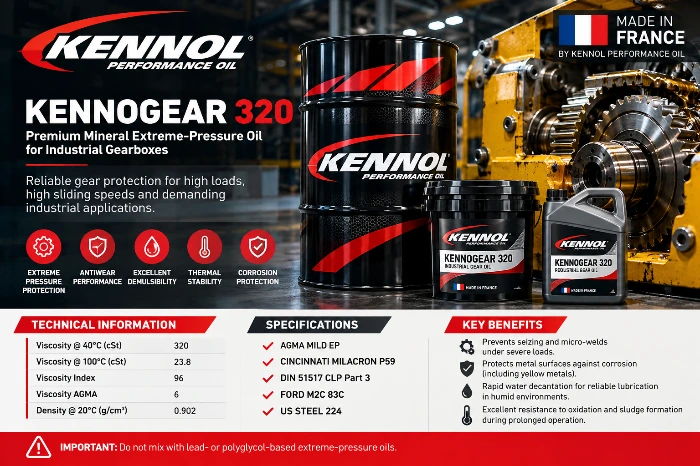
    KENNOL KENNOGEAR 320 is a premium ISO VG 320 mineral-based extreme-pressure (EP) industrial gear oil engineered to protect heavily loaded gear systems. Manufactured in France by KENNOL Performance Oil, it combines carefully selected mineral base oils with extreme-pressure, antiwear, anticorrosion, and oxidation-resistant additives.

    For maintenance engineers, reliability managers, and industrial purchasing teams seeking dependable protection without unnecessary lubricant expenditure, KENNOGEAR 320 offers a compelling balance of technical performance, equipment protection, and long-term operating value.

    The French Engineering Advantage: Why KENNOL Outperforms Standard Industrial Gear Oils

    Industrial gear lubrication requires more than simply selecting an oil with the correct viscosity. Effective protection depends on maintaining a sufficient lubricating film, controlling friction, resisting oxidation, and protecting metal surfaces when operating conditions become severe.

    KENNOL Performance Oil brings French lubricant engineering expertise to these challenges, with products developed for demanding mechanical applications.

    KENNOGEAR 320 incorporates several important protective technologies:

    Extreme-Pressure and Antiwear Protection

    Under high contact pressures, the lubricating film between gear teeth can become extremely thin. EP additives provide additional surface protection under boundary-lubrication conditions, helping reduce the risk of localized adhesive damage, microsoldering, scuffing, and premature tooth-surface wear.

    This protection is particularly important in gearboxes exposed to repeated starts, sudden torque changes, and impact loading.

    Corrosion and Rust Resistance

    Moisture contamination can attack steel gears, bearings, and internal gearbox components. KENNOGEAR 320 incorporates corrosion-inhibiting chemistry designed to protect metal surfaces, including compatible yellow-metal components, against moisture-related deterioration.

    Material compatibility should always be confirmed against the gearbox manufacturer's requirements.

    Water Separation and Demulsibility

    Water contamination can compromise lubricating-film integrity and accelerate mechanical damage. KENNOGEAR 320's demulsifying properties promote separation of free water from the lubricant, allowing it to settle for removal through appropriate maintenance procedures.

    This characteristic is especially valuable in humid industrial environments.

    Thermal and Oxidation Stability

    Continuous gearbox operation exposes lubricants to heat, oxygen, and mechanical stress. Oxidation-resistant formulation helps limit sludge formation, viscosity deterioration, and harmful deposits during prolonged service.

    Unlike generic oils selected primarily on price, a properly specified industrial gear lubricant should be evaluated on its ability to support equipment reliability and total operating cost.

    Technical Breakdown & Official Specifications (DIN 51517 CLP, AGMA, US Steel)

    KENNOGEAR 320 is formulated for industrial gear applications requiring ISO VG 320 viscosity and extreme-pressure performance.

    Technical Characteristics

    PropertyKENNOGEAR 320
    Lubricant TypeMineral-based EP industrial gear oil
    ISO Viscosity GradeISO VG 320
    Kinematic Viscosity at 40°C320 cSt
    Kinematic Viscosity at 100°C23.8 cSt
    Viscosity Index96
    AGMA Viscosity Grade6
    Density at 20°C0.902 g/cm³
    Country of ManufactureFrance
    ManufacturerKENNOL Performance Oil

    The 320 cSt viscosity at 40°C places the product in the ISO VG 320 category, suitable for industrial gearboxes designed to operate with relatively high-viscosity lubricants.

    Its 23.8 cSt viscosity at 100°C characterizes its behavior at elevated temperatures, while the viscosity index of 96 describes the oil's viscosity-temperature relationship.

    Correct lubricant selection must account for operating temperature, gearbox design, loading, rotational speed, and the original equipment manufacturer's viscosity recommendation.

    Stated Industry Specifications

    KENNOGEAR 320 is identified as meeting the following specifications and requirements:

    • AGMA MILD EP — Industrial gear lubricant performance classification.

    • DIN 51517 Part 3 (CLP) — Requirements for industrial gear oils with enhanced load-carrying characteristics.

    • US STEEL 224 — Industrial gear lubricant specification.

    • CINCINNATI MILACRON P59 — Industrial lubrication specification.

    • FORD M2C 83C — Ford lubricant specification.

    These references help maintenance professionals assess lubricant suitability against equipment documentation.

    Engineering note: A listed specification should not automatically be interpreted as a current third-party certification or OEM approval. Verify the latest KENNOL technical data sheet and the equipment manufacturer's requirements before making a substitution.

    The "Perfect Fit": Ideal Applications for KENNOGEAR 320

    KENNOGEAR 320 is particularly relevant to industrial gear systems operating under substantial mechanical loads where the equipment manufacturer specifies an ISO VG 320 mineral EP lubricant.

    Potential applications include:

    Heavy-Duty Industrial Gearboxes

    Enclosed gear reducers and power-transmission systems exposed to sustained torque, variable loading, and continuous industrial service.

    Manufacturing and Production Equipment

    Industrial machinery operating in repetitive production cycles, where stable lubrication contributes to equipment reliability and predictable maintenance planning.

    Conveyors and Material Handling Systems

    Gear-driven conveyors, lifting equipment, and material-handling installations experiencing frequent starts, stops, or changing loads.

    Mining, Aggregate, and Processing Equipment

    Suitable gearbox applications in demanding industrial environments, provided the equipment's viscosity, EP performance, and lubrication requirements match the product.

    Steel Processing and Heavy Mechanical Drives

    Industrial reduction gear systems subject to substantial contact stresses and extended operating periods.

    Why ISO VG 320 Matters

    Selecting the correct viscosity is fundamental to gearbox reliability.

    Oil that is too thin may fail to maintain adequate film thickness under the intended operating conditions. Oil that is excessively viscous can increase churning losses, operating temperatures, and energy consumption.

    KENNOGEAR 320 should therefore be selected based on the gearbox manufacturer's prescribed viscosity grade, not simply because the equipment operates under heavy loads.

    For maintenance departments, correct viscosity selection combined with effective contamination control can help reduce wear-related failures and avoid unnecessary maintenance expenditure.

    Critical Maintenance & Handling: The Polyglycol Non-Mixing Rule

    Even a high-quality industrial lubricant can perform poorly if incompatible fluids are mixed or contamination is introduced during maintenance.

    CRITICAL WARNING: NEVER MIX KENNOGEAR 320 WITH LEAD-BASED EXTREME-PRESSURE OILS OR POLYGLYCOL-BASED (PAG) GEAR LUBRICANTS.

    Mixing incompatible lubricant chemistries may cause phase separation, additive incompatibility, deposits, loss of lubrication performance, or equipment damage.

    Recommended Changeover Procedure

    1. Identify the existing lubricant. Confirm whether the gearbox currently contains mineral oil, synthetic hydrocarbon oil, polyglycol lubricant, or another specialized formulation.

    2. Review manufacturer compatibility requirements. Check the gearbox OEM instructions, lubricant technical documentation, and any seal or coating compatibility restrictions.

    3. Drain the existing lubricant correctly. Remove the used oil following the equipment manufacturer's maintenance procedure.

    4. Clean or flush when required. If the previous lubricant is incompatible, follow an OEM-approved flushing or conversion procedure before introducing KENNOGEAR 320.

    5. Inspect the lubrication system. Examine filters, magnetic drain plugs, seals, breathers, and accessible internal surfaces for contamination or abnormal wear.

    6. Refill to the specified level. Use the correct oil quantity and follow the manufacturer's operating and inspection procedures.

    7. Monitor after conversion. Check operating temperature, lubricant appearance, water contamination, and abnormal noise during initial operation.

    Moisture Management

    Although KENNOGEAR 320 offers demulsifying properties, water should not be allowed to accumulate in the gearbox.

    Routine inspection, appropriate breather maintenance, water drainage, and periodic oil analysis remain essential elements of an effective industrial lubrication program.

    Demulsibility supports water removal; it does not eliminate the need for contamination control.

    The Complete KENNOL Gear Protection Ecosystem at HICOStore

    Industrial facilities rarely operate identical gearboxes under identical conditions. Different equipment designs and operating environments require different lubricant viscosity grades.

    The broader KENNOL KENNOGEAR industrial lubricant range includes:

    ProductISO Viscosity Grade
    KENNOGEAR 68ISO VG 68
    KENNOGEAR 100ISO VG 100
    KENNOGEAR 150ISO VG 150
    KENNOGEAR 220ISO VG 220
    KENNOGEAR 320ISO VG 320
    KENNOGEAR 460ISO VG 460

    This viscosity range allows maintenance professionals to evaluate lubricant options across multiple industrial gearbox applications while maintaining a consistent supplier and product-family strategy.

    KENNOL also offers its Grand Prix performance lubricant line, reflecting the company's broader involvement in demanding automotive and performance lubrication markets. Racing lubricants and industrial gear oils serve different engineering requirements and must not be treated as interchangeable.

    Why Source KENNOL Through HICOStore?

    At HICOStore, we understand that industrial lubrication decisions affect more than purchasing budgets. They influence equipment reliability, maintenance planning, and operational continuity.

    Our goal is to help industrial buyers identify suitable lubrication products using verified technical specifications, clear product information, and commercially competitive sourcing options.

    Choosing KENNOGEAR 320 means considering a French-manufactured lubricant engineered for high-load industrial gear protection—not merely purchasing another drum or container of oil.

    When properly matched to equipment requirements and supported by sound maintenance practices, quality EP gear lubrication can contribute to lower wear-related maintenance costs and improved equipment availability.

    Protect Your Gearboxes. Protect Your Production.

    Unplanned gearbox downtime can cost significantly more than the lubricant used to protect the equipment.

    Explore KENNOL KENNOGEAR 320 at HICOStore.com and discover industrial lubrication solutions designed for demanding mechanical applications.

    For technical product selection, volume purchasing inquiries, or assistance identifying the appropriate KENNOGEAR viscosity grade, contact the HICOStore team.

    KENNOL KENNOGEAR 320 — French Lubrication Engineering for Industrial Gear Protection.

    # AGMA 6 KENNOGEAR 320 Kennol
    Corteco Tractor & Agricultural Seals: Heavy-Duty Sealing Solutions for Farm Machinery
    Heavy-Duty Agricultural Sealing: Why Standard Automotive Seals Fail in the Field

    Every clutch looks fine on a dyno sheet until the boost comes in at 6,500 rpm and the tach climbs while the car doesn't. That moment usually sends builders hunting for a stronger clutch, and OS Giken comes up quickly in those searches. This guide compares OS Giken's twin plate and single plate options for performance builds so you can match the hardware to how your car is actually driven.

    The choice matters more than most people expect. Picking too little clutch means slip and glazed friction surfaces within a few track days. Picking too much clutch makes the car miserable in traffic, chattering and grabbing like a race car on a grocery run. The right answer depends on torque, usage, and how much daily drivability you're willing to trade.

    What Makes OS Giken Clutches Superior for High-Horsepower Builds?

    OS Giken has built drivetrain components in Japan for decades, and its clutches reflect a motorsport engineering mindset rather than an aftermarket bolt-on approach. The core advantage is how the clutch manages heat and clamp load together, since those two factors decide whether a clutch survives repeated high-torque launches.

    Heat is the real enemy. Every time a clutch slips during engagement, friction energy turns into heat, and once the friction material passes its working temperature, the coefficient of friction drops and slip feeds on itself. OS Giken designs spread that load across precisely machined friction surfaces and lightweight components that shed heat quickly between shifts. On multi-plate units, the energy is divided across more surface area, so each disc runs cooler under the same abuse.

    Torque capacity comes from geometry rather than brute spring pressure. Adding friction surfaces raises holding power without needing a punishing clamp load, which keeps pedal effort reasonable and reduces stress on the release bearing, fork, and crank thrust bearing. That's the engineering trade most cheap "stage" clutches get wrong: they crank up spring force and call it a day.

    The result is predictable engagement at high power levels, consistent behavior when the clutch is hot, and a component that holds its rated torque lap after lap instead of fading during the third session.

    Single Plate vs. Twin Plate OS Giken Clutch Kits: Key Differences

    The simplest way to frame it: a single plate gives you one pair of friction surfaces, and a twin plate gives you two. Doubling the friction surface roughly doubles holding capacity at a similar clamp load, but it changes how the clutch feels and behaves in every other way.

    Factor

    Single Plate

    Twin Plate

    Pedal feel

    Progressive, closer to OEM

    Firmer, shorter engagement zone

    Engagement

    Smooth, forgiving launches

    Quick, more on/off character

    Power limit

    Moderate to strong NA and mild boost

    High boost, big torque, heavy track use

    Noise

    Generally quiet

    Some rattle at idle is normal

    Rotating mass

    Depends on flywheel choice

    Often lighter assembly for fast revs

    The Street-Friendly OS Giken Single Plate

    The single plate suits strong naturally aspirated engines and moderately boosted setups that still see street miles. Engagement is progressive, so pulling away on a hill or creeping through a parking garage doesn't require surgical footwork. Pedal effort stays close enough to stock that a passenger won't notice anything unusual.

    For a well-built K24 making solid NA power or a turbo car running conservative boost, a single plate often provides all the holding power required. It also costs less to buy and service, which matters when you're budgeting the whole build.

    The Track-Focused OS Giken Twin Plate

    The twin plate is built for drivers who regularly put serious torque through the drivetrain. Two discs mean far more holding capacity, better heat management during repeated launches, and stability through long track sessions where a single disc would start to fade.

    The trade-off is character. Engagement happens over a shorter pedal range, launches require more precision, and some rattle or gear noise at idle is part of the deal. Owners who understand that going in tend to love it. Owners expecting OEM manners usually don't.

    Signs You Need an OS Giken Twin Plate Clutch Upgrade

    Not every build needs a twin plate, but some clearly do. These are the indicators that a single plate has reached its limit:

    • Slip under high boost. If the revs flare in third or fourth gear when boost peaks, especially once everything is warm, the clutch can't hold peak torque. Slip in higher gears at full load is the classic symptom.

    • Torque beyond the single plate rating. Check the manufacturer's rated capacity for your kit. If your dyno numbers sit near or above that figure after a turbo upgrade, bigger injectors, or a new tune, you're running without margin. A twin plate restores that buffer.

    • Heavy track usage. Repeated hard launches, drag passes, or long road course sessions heat the clutch far beyond what street driving does. A burning smell after a session or engagement that changes as the car gets hot points to thermal overload.

    • Glazed or rapidly worn discs. Pulling a single plate that looks shiny, blued, or worn thin after a short service life tells you it's being overworked.

    • Planned power increases. If the next phase of your build adds significant torque, install the twin plate now rather than doing the clutch job twice.

    A useful rule from the shop floor: if you're asking whether you have enough clutch, you probably need to look at the next step up. Clutches don't fail gradually when they're undersized. They work until one hard pull, then they don't.

    OS Giken Clutch Compatibility: Honda K-Series (K20/K24) and Beyond

    The Honda K-Series is one of the most common platforms for OS Giken clutch kits, and for good reason. The K20 and K24 respond extremely well to modification, whether that's high-compression NA builds revving past 8,000 rpm or turbo setups making several times their factory output. The factory clutch was never designed for either.

    For K20 builds that stay naturally aspirated, the appeal is often reduced rotating mass. A lighter clutch and flywheel assembly lets the engine rev more freely, which suits the K20's high-rpm character and makes heel-toe downshifts sharper. The K24, with its added displacement and torque, pushes the clutch harder from lower in the rev range, so a boosted K24 is a prime candidate for a twin plate.

    Common K-Series applications include Civic Type R, Integra RSX, Civic Si, and engine swap chassis like the EG and EK Civic or the S2000. Swaps require careful attention to which transmission you're running, since bellhousing and input shaft details determine the correct kit, not just the engine code.

    Beyond Honda, OS Giken supports a wide range of performance platforms, including Nissan SR20 and RB engines, Toyota 2JZ and 86/GR86 applications, Subaru EJ and FA engines, and Mitsubishi 4G63. Always confirm the exact part number against your engine, transmission, and model year before ordering.

    Proper Break-in Procedure for OS Giken Multi-Plate Clutches

    A new clutch needs time for the friction surfaces to mate properly with the flywheel, pressure plate, and intermediate plate. Skip this and you risk uneven contact, hot spots, glazing, and chatter that never fully goes away. The cost of patience is a few hundred miles. The cost of impatience is another clutch job.

    Follow these steps after installation:

    1. Confirm installation before driving. Verify correct torque on pressure plate bolts in a crisscross pattern, check pedal free play and hydraulic bleeding, and make sure the clutch fully disengages before the first drive.

    2. Drive gently for the first 300 to 500 miles. Use the manufacturer's recommended figure for your specific kit, and keep engagement smooth with modest throttle.

    3. Avoid full-throttle launches and aggressive shifts. No drag starts, no clutch kicks, no high-rpm dumps during this period.

    4. Vary your engagement. Normal stop-and-go driving with moderate rpm engagement helps the surfaces bed evenly. Mixed city and highway driving works well.

    5. Avoid prolonged slipping. Riding the clutch builds heat before the surfaces have properly seated.

    6. Recheck pedal adjustment after break-in. Engagement point can shift slightly as the surfaces settle.

    Expect some noise from twin plate units at idle. That's the floating plates and is not a sign of improper break-in.

    Selecting the Right Performance Drivetrain Partner

    The single plate versus twin plate decision comes down to honest answers about your build. A single plate keeps the car pleasant on the street and handles strong NA and moderate boost setups well. A twin plate earns its place once torque climbs past what one disc can reliably hold, or when repeated track heat starts cooking the friction surfaces. Match the clutch to your real torque figure and your actual driving, then give it a proper break-in so it lasts.

    Where you buy matters as much as what you buy. Counterfeit and gray-market drivetrain parts do circulate, and a clutch is the last place you want questionable materials or tolerances. HICOStore is an authorized distributor of genuine OS Giken performance parts, with fast shipping across the US and internationally. Confirm your platform, pick the right configuration, and order from a source you can trust, because the best clutch is the one you never have to think about again.

    Racing parts, motorsport transmission, sequential gearbox, high hp clutch, JDM racing distributor.
    • Home
    • About us
    • Products


    • Privacy Policy Refund and Return Policy Terms of Service
    Follow us
    Hicostore.com is a global brand owned by HICO GROUP. In the United Kingdom and Europe, services are provided by HICOSTORE LTD (Company No. 17035559). In the United States, services are provided by Hicostore Group Holdings LLC
    English (CA) | English (UK) | English (US) | Français (CA) | Português (BR) | Español (América Latina)
    Powered by Odoo - The #1 Open Source eCommerce

    We use cookies to provide you a better user experience on this website. Cookie Policy

    Only essentials I agree